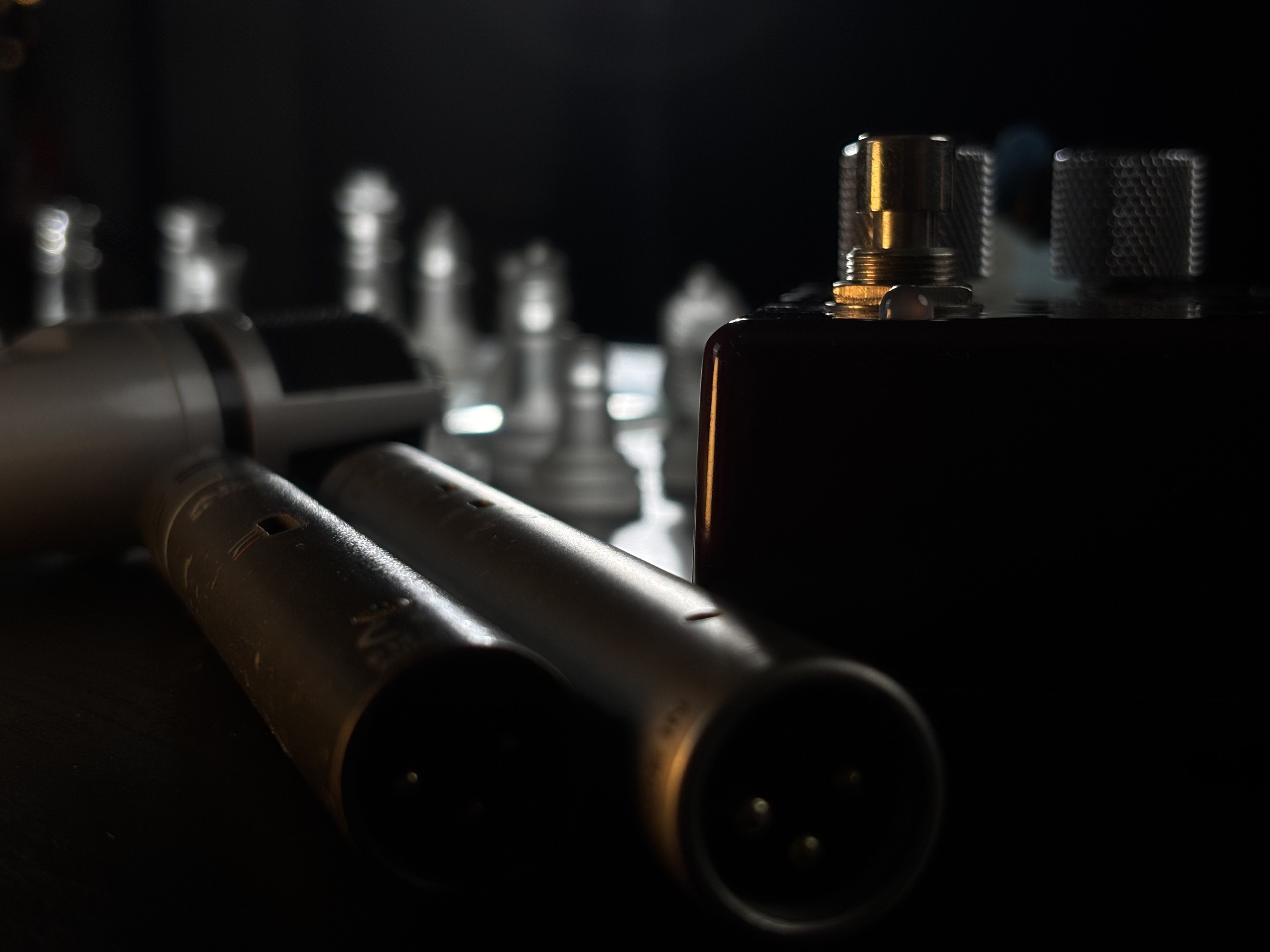
Microphone setup
Where the microphones stand is designed before anybody records, against the room they will be standing in and the voice they will be pointed at.
The short version
Is this for you? For the room baked into every recording, and microphones placed by habit. Whether or not anyone here has stood in the room, the positions can be read by ear from the files you already have. Not if your sound is already clean where you record; placement is the fix for a room fighting you, and not every room is.
What leaves your plate. The voice measured before the position is chosen, placement decided so the room can be taken out later instead of never, and two sources sharing one space solved as geometry rather than bought as a plugin.
What starts working. Sources separated enough to balance independently, a room that can be quietened without hollowing the voice, and a placement written down with its reasoning for whoever sets it up next.
The smallest way in. A free audit: three fields, and a written reading back, usually within about three working days. It commits you to nothing.
What to read next. The five levels to see where this fits, or the casework to see it done.
Where placement stops being wherever the stand fits
How many inputs there are, and what each one is there to give the mix, is settled on the multi-microphone setups page; this one is only about where those microphones physically stand, in the room you actually record in.
A microphone can be located from the file it made
One partnership was sending us recordings in which the instrument and the teaching arrived on top of each other. Nobody here had ever seen the room. The positions were worked out by ear from the delivered audio, put back to the partner to be confirmed, and a new arrangement designed from what came back. A recording will tell you where its microphones were standing, if somebody is willing to sit and listen for it.
Placement decides whether the room can ever be taken out
Room tone lifts cleanly out of a recording when the source in front of it is loud and separate; when it is neither, it barely lifts, and not without taking some of the voice with it. That is settled by geometry on the day. The change on that partnership was not a plugin and it was not a better microphone: the stands moved, and the room became something that could be quietened afterwards without the voice thinning out with it.
The voice gets measured before the position is chosen
Somebody who projects and somebody who murmurs are two different acoustic problems in the same chair. A lesson that alternates between speaking and playing needs a position that survives both without a hand on a fader. So the design starts from the person and the material in front of them, and the equipment question comes last, if it arrives at all.
Two sources in one room is a geometry problem
Where an instrument and a voice share a space, the first question is never which microphone to buy. It is where each one has to stand so that each source arrives loudest where it is wanted and quietest where it is not. Distance and angle cost nothing and decide almost everything, which is why they are worth an hour of somebody's attention weeks before a shoot day.
The order the decision happens in
The sequence, not the numbers. Distances belong to the room and the voice, and they are chosen per setup.
| Read from | the files already delivered |
|---|---|
| Confirmed with | whoever set the microphones up |
| Decided against | the room, the voice, and what the mix has to separate |
| Room advice | on a video call, before anything is bought |
| Re-checked | on the first batch recorded after the change |
Every input, and the job it has
What actually gets decided
Distance, height and angle for every input. What the spare input is doing. Which source is allowed to bleed into which, because some bleed is useful and some is fatal. Whether the room needs something soft in it before moving a microphone is worth doing at all. All of it written down as positions somebody can rebuild next month without ringing anyone.
How a room gets advised on from another country
The files come first and the conversation follows them. Where a space needs looking at, it gets looked at on a video call: what the floor is, what the walls are, where the noise comes in, and which of those can be improved with a rug and a closed door before anything is bought. Advice given to a room nobody has stood in has to be checked, so the first batch of files after a change is listened to specifically for whether the change worked.
What a room contributes whether it is invited to or not
A hard floor under a low ceiling puts a short bright reflection on everything in it. A glazed wall does the same thing louder. A fridge two rooms away arrives as a low hum that is inaudible in person and unmissable through headphones. None of that is a fault in the microphone, and every one of them is decided by where the microphone was put.
Room noise became removable once the microphones moved, and nothing in the software had changed.
Geometry on the day decides what a plugin can do later, or cannot.
What changes for you
Sources that arrive separated enough to be balanced independently, a room that can be quietened without taking the body out of the voice, and a placement written down with its reasoning beside it, so the next person to set that room up is not guessing at somebody else's decision.
Related: Multi-microphone setups · Noise removal · Shoot planning · Camera and lighting setup
Most fixes here cost nothing on the day of the shoot and everything after it. The audit reads recent videos for what should have been decided before recording, and puts the list in writing.
Request your free audit.
Three fields, and a written reading back: a fit snapshot, two or three prioritised opportunities, and a recommended next step.
A person reads the channel and writes the audit by hand: a considered read typically takes three working days. That is the usual shape, not a promised turnaround. We use these details only to reply to you: no lists, no lurking.
What you will get
A fit snapshot: where your channel stands, and whether we are a match.
Two to three opportunities: specific, prioritised, yours to keep.
A recommended next step, even if that step is not us.
The audit is free and commits you to nothing: nobody follows up with a call you did not ask for.
The casework shows all of this done.
The case studies are the same work with the numbers, the sources and the dates attached.
See the casework →