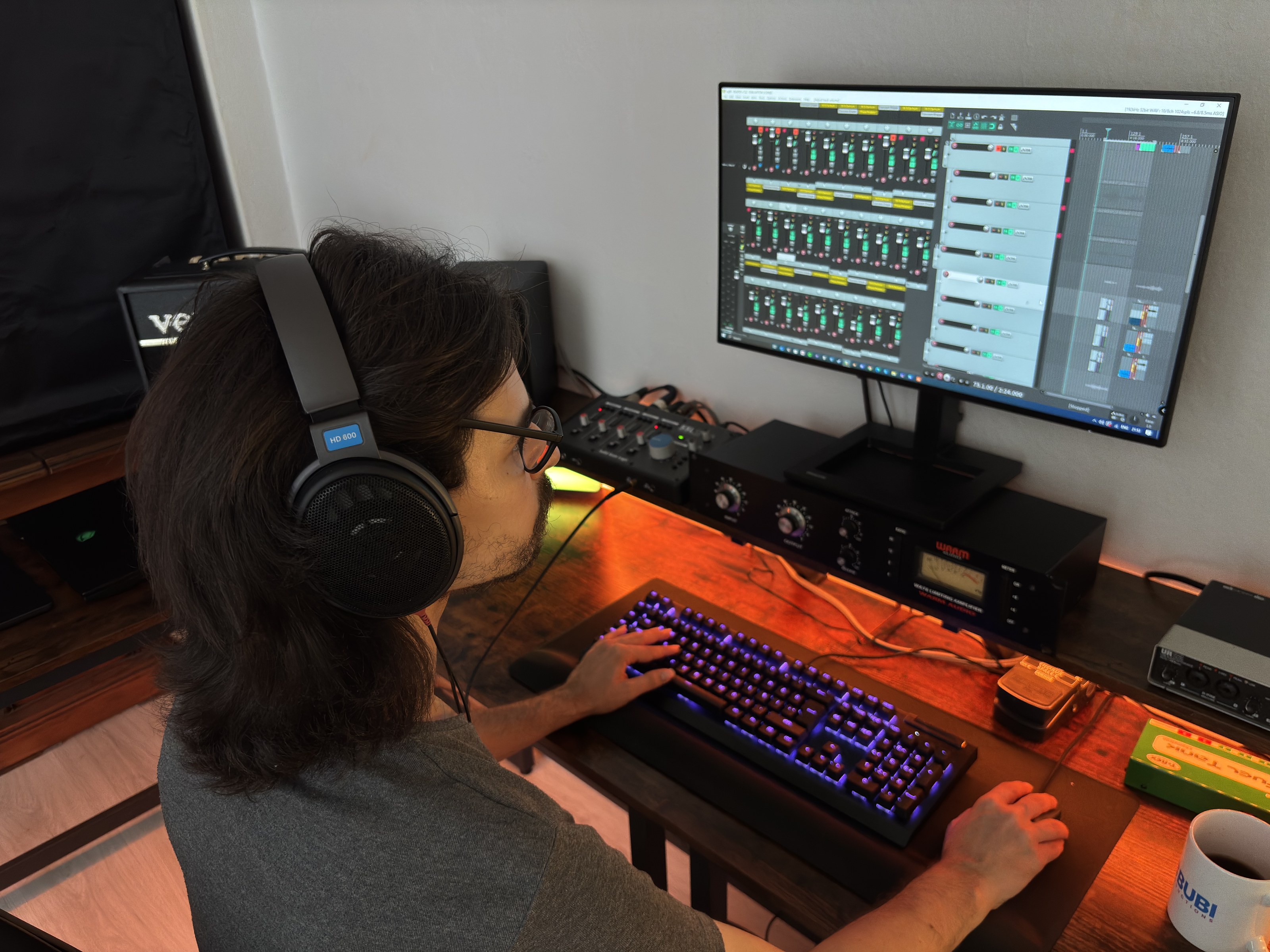
Audio post-production
Good video production shows your investment. Good audio production is the part nobody compliments and most people feel without naming: it protects the voice, holds the levels steady, and keeps music and effects in their place.
The short version
Is this for you? For any channel getting comments about its audio, or losing the lesson under the room. It goes deepest where the subject has a sound of its own, an instrument, a workshop, a kitchen, because that is where a composer's ear earns the most. Not if your sound is already clean; a single voice in a treated room is a smaller win than this line is built for.
What leaves your plate. Audio scoped alongside the camera and run as one process, not a favour bolted on at the end by whoever happens to be free.
What starts working. Nobody compliments the sound; they call the production professional and stay a little longer. Handled this way, your brand can have a voice in the literal sense, not only a typeface.
The smallest way in. A free audit: three fields, and a written reading back, usually within about three working days. It commits you to nothing.
What to read next. The five levels to see where this fits, or the casework to see it done.
A brand has a voice in the plain sense of the word. The room around the sentences, the decibel or two the music gives up when someone starts speaking, the breath left in because a person was thinking: nobody names any of it from the sofa, and everybody recognises it. One of this studio's founders is a composer, and this line is run with that ear. Brand voice is usually a typography decision. Here it can also be a sound.
Where this stops being ordinary
Sound is scoped at the same time as the camera
Audio is normally scheduled as a finishing task, after the picture is locked. Here it is scoped at the same time as the camera, because almost every audio problem worth solving is created before anyone presses record, and the ones created there cannot be solved later at any price.
Phase is checked before a single fader moves
A millisecond of misalignment between two microphones is heard as a hollowing that most listeners feel and nobody can name. It is also the fastest way to make an expensive recording sound cheap. With a multi-microphone setup, phase is the first thing checked and the last thing trusted.
Two goals held at once, deliberately
A lesson is mixed like a record so the instrument has depth, then balanced so the teaching stays legible over it. Those two goals fight, and the fight is the job. A lesson that sounds beautiful and cannot be followed has failed, and so has one that is perfectly clear and lifeless.
One mix, a master for each destination that needs one
The same mix is finished separately for wherever it lands, because a platform's playback is not a neutral thing you can ignore. Where two destinations play back alike, one carefully prepared master serves both, and for a single video in one place we will tell you to skip the extra pass. The export law that governs it is agreed once per partnership and written down.
Written down in advance, per destination
The export law, codec, sample rate, bit rate and where the master meter may sit, is settled once per partnership. The full table lives on the mastering page, so the same numbers are never maintained in two places.
The part usually treated as an afterthought
What the work actually involves
Multi-track assembly from the separate microphone sources. Phase correlation across those sources. Frequency build-up managed at the source, before anything gets notched away. EQ chosen per voice and per room. Saturation where a source needs weight it never had. Sidechain compression so music sits under speech instead of arguing with it. Mid-side work where a room deserves to be wide and a voice does not. Then noise, then levels, then a master for each destination that needs one.
The rule of thumb, stated honestly
Fix it in the recording, perfect it in the mix. Almost everything in this section is easier, cheaper and better if it is handled before the camera rolls, which is why the advice arrives before the shoot and not after it. When that is not possible, and it often is not, the mix is where it gets solved, and it gets solved properly rather than covered.
Good video production shows your investment. Good audio production is quieter than that: it protects the voice and the levels, and works best when nobody notices it.
Investment is what your audience sees; good sound is what it feels without being able to name.
What changes for you
Nobody watching will say a word about the sound. They will say the production is professional, and clean sound is the kind of thing that keeps people watching a little longer without their knowing why.
Related: Noise removal · Audio mixing · Mastering for platform · Multi-microphone setups · Phase alignment
Audio problems hide in plain sight because viewers feel them without naming them. The audit listens through recent videos and puts in writing what the sound is costing and what would fix it first.
Request your free audit.
Three fields, and a written reading back: a fit snapshot, two or three prioritised opportunities, and a recommended next step.
A person reads the channel and writes the audit by hand: a considered read typically takes three working days. That is the usual shape, not a promised turnaround. We use these details only to reply to you: no lists, no lurking.
What you will get
A fit snapshot: where your channel stands, and whether we are a match.
Two to three opportunities: specific, prioritised, yours to keep.
A recommended next step, even if that step is not us.
The audit is free and commits you to nothing: nobody follows up with a call you did not ask for.
The casework shows all of this done.
The case studies are the same work with the numbers, the sources and the dates attached.
See the casework →