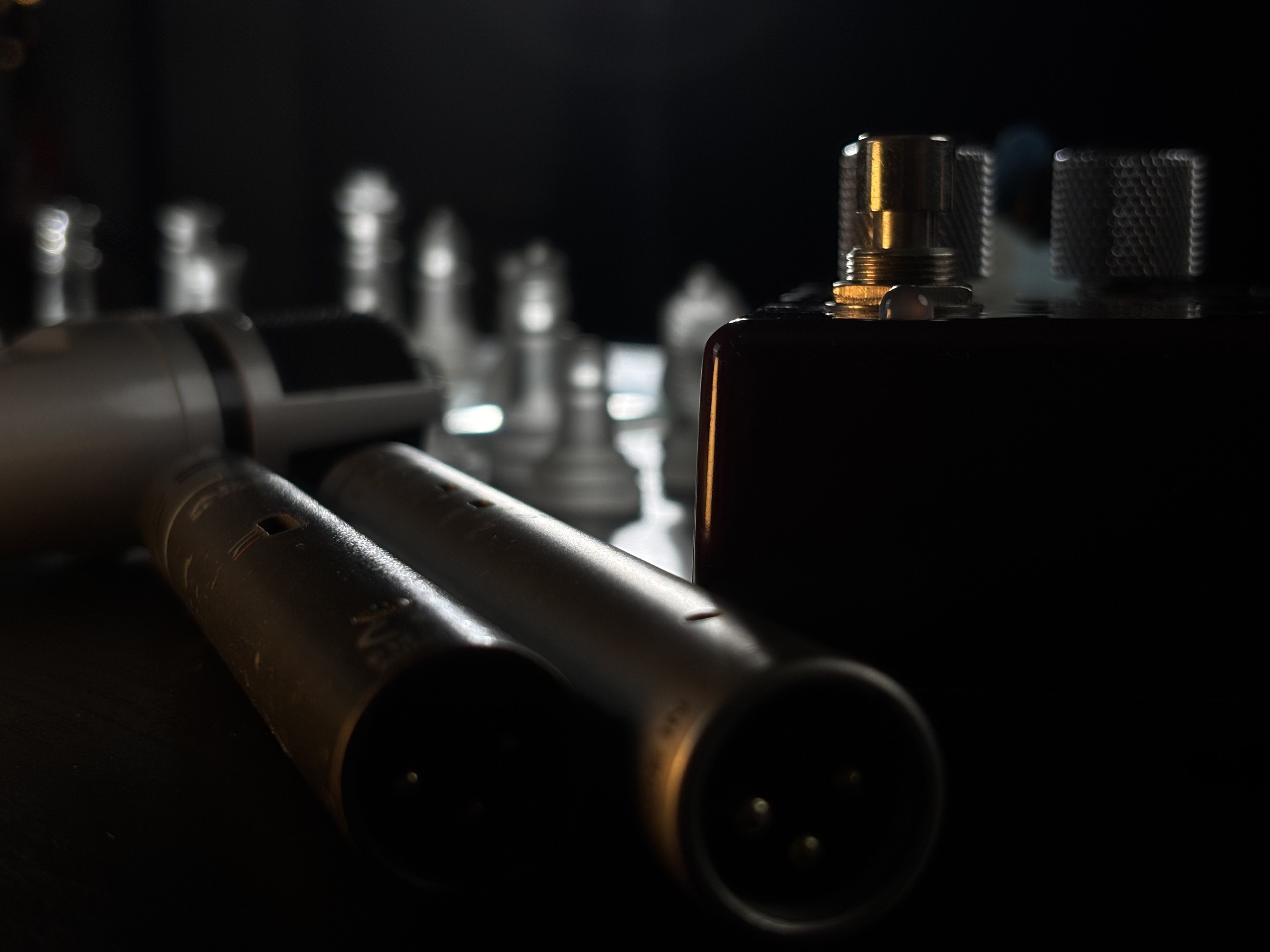
Phase alignment
Checked before a single fader moves, because timing between correlated microphones shapes a sound most people feel and almost nobody can name.
The short version
Is this for you? For the hollow voice nobody can diagnose, where two microphones on one source are quietly cancelling each other. With a single microphone there is nothing here to fix.
What leaves your plate. The check done before any fader moves, and a rig designed so the result never depends on the editor happening to have good ears.
What starts working. A recording that sums to more than it started with: low end where it was played, a voice forward without being pushed, and every later mix decision made against something stable.
The smallest way in. A free audit: three fields, and a written reading back, usually within about three working days. It commits you to nothing.
What to read next. The five levels to see where this fits, or the casework to see it done.
A millisecond has a sound
It happens before a single fader moves
Nothing else in the mix is worth doing while two microphones meant to agree are fighting. Balance a misaligned pair and the balance is a compromise between two versions of the same sound cancelling each other, so every subsequent decision is made against a moving target. Phase gets checked first, every time, on every source that has a second, redundant capture close to it. A deliberately spaced pair, a stereo technique or a distant room microphone is the opposite case: there the timing difference is the point, it carries width and depth, and it is judged by ear rather than aligned away.
A millisecond has a sound, and it is a hollowing
Two microphones at slightly different distances receive the same wave at slightly different moments, and the sum loses whatever the two disagree about. What reaches a listener is thinner and less present than it should be, hollowed at frequencies the distance between the two microphones decides. Almost nobody can name it. Everybody feels it, and most of them blame the room.
The setup was designed so that nobody has to be lucky
The founder's own framing for the five-microphone rig: with this setup there is no fear of an editor who would not notice. That is the real argument for planning capture and post together. A recording that depends on the person who opens it happening to have good ears is a recording that will eventually meet somebody who does not.
It is the first thing checked and the last thing trusted
Alignment gets rechecked after anything that could disturb it: a new take, a replaced source, a re-synced angle, a plugin with latency it did not declare. The correlation meter is watched throughout rather than ticked off at the start, because a mix that was in phase before those changes is not automatically in phase after them.
Why two microphones disagree, and what settles it
Where the problem comes from
Distance, mostly. Sound travels at a fixed speed, so two microphones at different distances from one source are always slightly out of step, and the mismatch changes with frequency instead of sitting still. Then there is polarity, flipped by a miswired cable or a reversed input, which is a different fault with a similar symptom and a much faster fix.
How it gets treated
Correlation checked across every pair. Sample-level alignment where the fault is a delay, polarity inversion where it is a flip, and a decision about which capture holds the truth so the others move towards it and nothing drifts towards the middle. Where the recording cannot be saved this way, the honest answer is a retake, and it gets said.
The rule of thumb behind all of it
Two redundant captures of one source either agree or they cancel, and nothing downstream votes on it. That is the case this page is about; where the spacing between microphones is deliberate, as in a stereo pair or a room capture, the disagreement is information and gets kept. Alignment is cheap when microphone placement was considered and expensive when it was not, and there is a point past which no amount of nudging returns what two badly placed captures took from each other. That point is reached on set, hours before anybody opens a session. Read more: microphone setup →
With this setup there is no fear of an editor who would not notice, because every millisecond counts and the design assumes somebody is listening for them.
The founder, on why the rig was designed the way it was.
What changes for you
A recording that sums to more than it started with, never less. Low end that stays where it was played, a voice that sits forward without being pushed, and a mix whose every later decision was made against something stable.
Related: Multi-microphone setups · Audio mixing · Audio post-production · Noise removal
Audio problems hide in plain sight because viewers feel them without naming them. The audit listens through recent videos and puts in writing what the sound is costing and what would fix it first.
Request your free audit.
Three fields, and a written reading back: a fit snapshot, two or three prioritised opportunities, and a recommended next step.
A person reads the channel and writes the audit by hand: a considered read typically takes three working days. That is the usual shape, not a promised turnaround. We use these details only to reply to you: no lists, no lurking.
What you will get
A fit snapshot: where your channel stands, and whether we are a match.
Two to three opportunities: specific, prioritised, yours to keep.
A recommended next step, even if that step is not us.
The audit is free and commits you to nothing: nobody follows up with a call you did not ask for.
The casework shows all of this done.
The case studies are the same work with the numbers, the sources and the dates attached.
See the casework →